 Skip to content

In Worcester, with Dr. Heinis or Lawrence
Meet Dr. Chris Heinis or Lawrence at 292 Lincoln Street, where every transplant is done.

A wider part, more scalp under bright light, more hair in the brush. Hair loss is common in women, and it usually has a cause that can be found. We find yours first, then match the treatment to it: care without surgery, or a hair transplant when your hair loss is genetic.
Confidential consultations in Worcester, Lexington (near Boston), Bedford and Warwick, or by video if you can't make it in.
Dr. Chris Heinis oversees every procedure and makes every incision himself. 15,000+ hair transplants since 1993.
Men usually lose hair at the hairline and the crown. In women it most often thins on top: the part widens and more scalp shows, while the hairline usually holds. Drawn hair by hair, this is how a transplant fills a part.
Shedding some hair every day is normal. Hair loss is when you shed more than about 100 hairs a day, or the hair you lose isn't replaced. Men's hair loss is almost always genetic; women's has many possible causes, and often more than one.
Every plan begins with a confidential consultation, in person or by video. The treatment follows the cause.
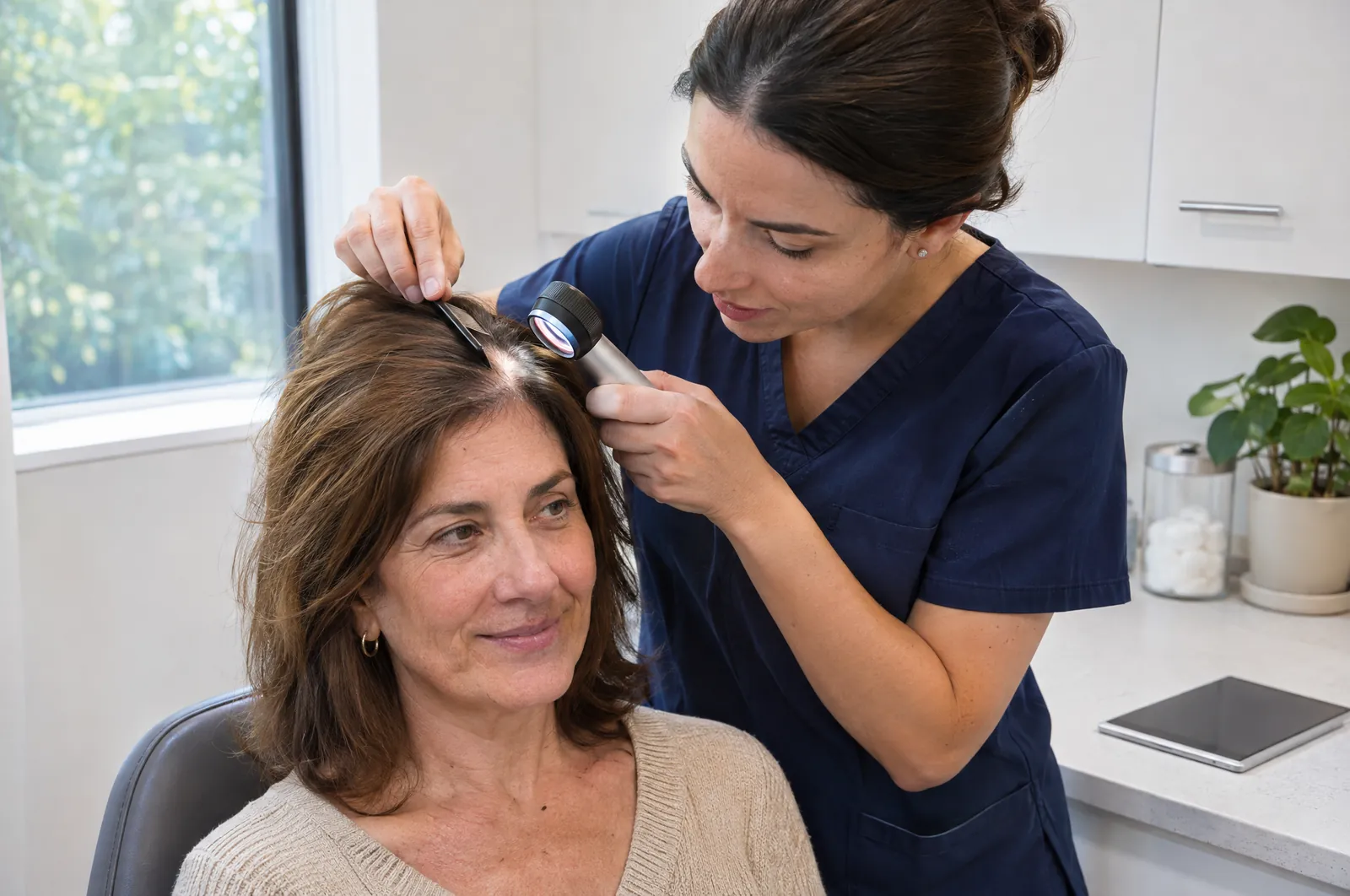
When it started and how it has changed, your health, your medicines, and what has been going on in your life.
Where your hair is thinning and how much, and how strong the hair at the back of your head is: it's the hair a transplant would use.
Whether your hair loss is genetic or tied to your overall health. We can test for vitamin deficiencies.
A plan made for you: treatment without surgery, a transplant, or both. If a transplant isn't right for you, we'll say so.
When your hair loss isn't genetic, these come first, and they help protect the hair you have when it is. Your plan may use one or several.

Low-level laser therapy. Red laser light reaches deep into the follicle and gives it energy to grow, so resting follicles wake and grow thicker hair. It fits inside any hat, for treatment wherever you go.
About LaserCap
A compounded prescription topical: minoxidil (5%), tretinoin, a topical steroid and other ingredients that make it more effective, stable and easy to use, with a longer shelf life.
About Formula 82M
Minoxidil (5%) and finasteride (0.25%) with retinoic acid, oleanolic acid and algae extracts. It is for men and women. Because it contains finasteride, a clinician reviews and approves it for you, and it is not for women who are pregnant or may become pregnant.
About Formula 82F
An alcohol-free foam with latanoprost, minoxidil and spironolactone, made to help thicken hair and reduce shedding.
About PhytoFoamRx
Transplanted hair is your own, so it grows, and you cut, color and style it like the rest.
When your hair loss is genetic and the hair at the back of your head is strong, a transplant moves it to where you've thinned. Hair from the back resists the hormone behind pattern hair loss, so it keeps growing. Women can have all three of our methods.
| No-Shave FUE | Standard FUE | FUT | |
|---|---|---|---|
| Your hair | Nothing shaved or trimmed, at the back or where the grafts go | The back clipped short | Only the narrow strip at the back is trimmed |
| Grafts | Up to about 2,000 in one day | Up to 2,500 in one day; 3,000+ over two days | 3,000+ in one session |
| How grafts are taken | One at a time, with the Trivellini | One at a time, by hand | A narrow strip, divided into grafts |
| Scar | Tiny dots, hidden in your hair | Tiny dots, no linear scar | One thin line, closed so your hair grows over it |
| Back to normal | 3 to 5 days | 3 to 5 days | 10 to 14 days; staples out at about two weeks |
Not sure? Your consultation checks whether your hair loss and donor area suit a transplant, and which method fits you. Read about No-Shave FUE, FUE and FUT.
Straight numbers, before you book.
A transplant's price depends on your graft count and the areas you're restoring, and two days run about $15,000. Treatments without surgery are priced in your plan. You get exact figures at your consultation.
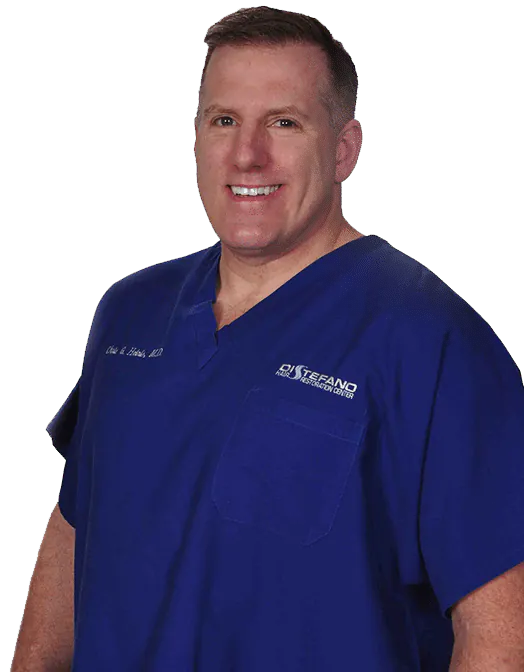
A board-certified physician who moved from emergency medicine to hair restoration, Dr. Heinis joined DiStefano in 2012 and has owned the practice since 2018. If a transplant is right for you, he plans it with you, oversees every procedure and makes every incision himself. Learn more about Dr. Heinis.
Joined DiStefano in 2012, owner since 2018.
Nearly ten years as an assistant professor at UMass.
Member of the International Society of Hair Restoration Surgery (ISHRS).
He oversees every procedure and makes every incision himself.
Verified five-star reviews from real DiStefano hair restoration patients across New England.
Yes, far more common than most people think, and more so with age, especially after 50. It can feel very personal, which is why every consultation is private.
Genetics, hormonal changes, thyroid problems, poor nutrition, physical or emotional stress, some medications and alopecia are the most common causes, and there can be more than one at once.
At a confidential consultation. We go over your history and look closely at where and how your hair is thinning, to tell genetic hair loss from loss tied to your health. We can test for vitamin deficiencies.
Often, when the cause is found and treated in time. Shedding from diet or stress is often temporary once it is treated. Genetic thinning can be slowed with treatment, and a transplant can restore hair where it has thinned.
Nutritional counseling, vitamin supplements, prescription medications, the LaserCap, and three topicals: Formula 82M, Formula 82F and PhytoFoamRx. Your plan may use one or several.
Yes. Formula 82F is for men and women. It contains finasteride, so a clinician reviews and approves it for each patient, and it is not for women who are pregnant or may become pregnant.
Yes. Women can have No-Shave FUE, FUE or FUT, and your consultation checks whether your hair loss and donor area suit a transplant.
Not with No-Shave FUE: nothing is shaved or trimmed, at the back or where the grafts go. It moves up to about 2,000 grafts in a day and needs hair at the back at least 1.5 inches long. With FUT, only the narrow strip where the grafts come from is trimmed, and the hair above falls over it.
Most patients are back to normal in 3 to 5 days after FUE or No-Shave FUE, and in 10 to 14 days after FUT. No exercise for 10 to 14 days.
New growth usually begins around three to four months, and full results take 12 to 18 months.
Yes. We guarantee the growth of every transplant. If grafts don't grow, you get a touch-up, as long as you follow your after-surgery plan.
$6,500 to $10,000 for a single day, and about $15,000 for two days. You get an exact figure at your consultation; financing through Cherry is available, and we'll beat any valid quote from a reputable clinic.
Yes. It is confidential, in person in Worcester, Lexington, Bedford or Warwick, or by video, with no obligation.
Pick the one that suits you, then fill out the form below, book online or call (508) 756-4247.
Meet Dr. Chris Heinis or Lawrence at 292 Lincoln Street, where every transplant is done.
Meet Lawrence, our senior consultant of more than 15 years, on his days at those offices.
If you can't make it to an office, meet Lawrence by video, from your phone or computer. Video can't be booked online: send the form below and say you'd like video, or call (508) 756-4247. Patients near Rocky Hill, CT start here.